Archaeology Courses
Archaeology courses explore ancient civilizations, excavation techniques, artifact analysis, and the use of technology in fieldwork. You can learn about the methods used to uncover historical sites, interpret findings, and understand cultural contexts. Topics might include stratigraphy, radiocarbon dating, and the application of Geographic Information Systems (GIS) in archaeological research.
Popular Archaeology Courses and Certifications

Rice University

Rice University
Skills you'll gain: Anthropology, Scientific Methods, Research

Universitat Autònoma de Barcelona
Skills you'll gain: Ancient History, Case Studies, Community Development, Sustainable Development, Surveys, Research, Research Methodologies, Culture
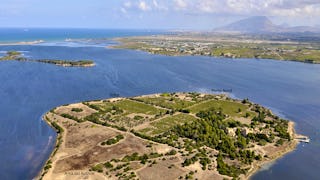
Sapienza University of Rome
Skills you'll gain: Ancient History

Rice University
Skills you'll gain: Timelines, Scientific Methods, Environment, Spatial Analysis, Culture, Biology
What brings you to Coursera today?

University of Arizona
Skills you'll gain: Ancient History, Art History
Sapienza University of Rome
Skills you'll gain: Ancient History, 3D Modeling, Scientific Methods, Data Modeling, Research, Data Management, Data Collection
Ludwig-Maximilians-Universität München (LMU)
Skills you'll gain: Ancient History, Governance, Economics
University of Pennsylvania
Skills you'll gain: Ancient History, Art History, Timelines
Rice University
Skills you'll gain: Ancient History, Anthropology, Culture, Case Studies, Research
Universitat Autònoma de Barcelona
Skills you'll gain: Ancient History, Anthropology, Culture, Language Learning, Social Studies, Art History, World History, Grammar, Literacy, Public History, Language Interpretation, Translation, and Studies, Writing, Architecture and Construction, Language Competency, Cultural Diversity, Investigation, Vocabulary, Economics, Timelines, Research

How to choose the right Archaeology course
Start with what you want to do in archaeology. If you're interested in fieldwork, choose courses that emphasize field methods, site excavation, and artifact recovery. If you want to focus on ancient civilizations of the Mediterranean, look for courses covering Mediterranean archaeology, historical context, and cultural practices. Compare these options to find the best fit for your interests.
Best free Archaeology courses
High-quality free Archaeology courses you can start today.
- Archaeology and Heritage of AfricaUniversitat Autònoma de BarcelonaBeginner1 - 3 MonthsFree
- At the Origins of the Mediterranean Civilization: Archaeology of the City from the Levant to the West - 3rd-1st millennium BCSapienza University of RomeBeginner1 - 3 MonthsFree
- Roman Art and ArchaeologyUniversity of ArizonaMixed1 - 3 MonthsFree
Best Archaeology courses from Rice University
Top-rated Archaeology courses offered by Rice University on Coursera.
- Introduction to ArchaeologyRice UniversityBeginnerRice University
- Introduction to Archaeology: Knowing The PastRice UniversityBeginner1 - 4 WeeksRice University
- Introduction to Archaeology : Archaeology as ScienceRice UniversityBeginner1 - 3 MonthsRice University
Best Archaeology courses for beginners
Top-rated beginner-friendly Archaeology courses with no prerequisites.
- Organising an Empire: The Assyrian WayLudwig-Maximilians-Universität München (LMU)Beginner1 - 3 MonthsNo prerequisites
- Introduction to Archaeology: Reconstruction of The PastRice UniversityBeginner1 - 3 MonthsNo prerequisites
- Egiptología y lectura de jeroglíficos para humanidadesUniversitat Autònoma de BarcelonaBeginner3 - 6 MonthsNo prerequisites










